Root Intrusion Removal. We don't punch temporary holes. We clear the pipe.
If you are paying a plumber every few months to clear roots out of your sewer line, you are not paying for a solution. You are paying a subscription fee. When tree roots infiltrate your main sewer line, they don't just cause a slow drain. They trap waste, toilet paper, and grease, eventually creating a massive, impenetrable blockage.
You're caught in the recurring plumbing subscription trap.
Many plumbing companies treat root intrusion as an artificially recurring revenue stream. When you call them for a drain cleaning emergency, they arrive with a standard steel cable auger.
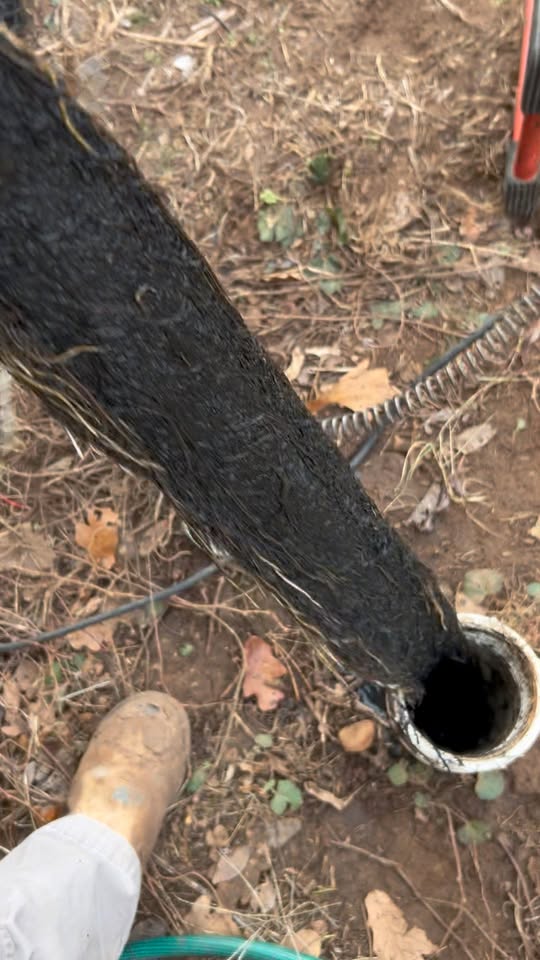
Mechanically, here is what they are doing: They are pushing an undersized 2-inch or 3-inch cutting head down a 4-inch or 6-inch main sewer lateral. When that small blade hits a massive root ball, it punches a narrow, temporary tunnel straight through the center.
The water immediately drains. The plumber declares the job a success, collects a dispatch fee, and leaves. But if you were to look down that pipe with a camera, you would see that 80% of the root structure is still completely intact, actively growing against the pipe walls. Within 30 to 60 days, those roots will rapidly expand, close the narrow tunnel, and cause another backup. You are trapped in a cycle of temporary band-aids.
Why roots always target Oklahoma sewer lines.
Roots don't crush pipes out of malice; they are simply seeking moisture. In the Oklahoma City metro, the shifting soil and extreme cycles of drought and flood wreak havoc on underground infrastructure.
Houses built decades ago were primarily plumbed with clay pipes. Clay is highly susceptible to ground movement. Over time, the heavy soil shifts, causing the joints between the clay pipe sections to separate. Once there is a microscopic gap in the joint, the moisture from the sewer line seeps into the surrounding soil.
Trees, bushes, and deep-rooted landscaping are highly efficient at finding water. Their hairline root fibers detect this moisture and grow directly into the separated joint. Once inside the nutrient-rich, constant-water environment of the sewer line, those microscopic fibers rapidly expand into massive, woody root mats that completely choke off the flow of waste to the city main.
"I’ve used these guys a few times now and they’ve been great every time. Their crew is always respectful, knowledgeable, and easy to work with. They show up when they say they will and get the job done right. Pricing has been fair too. Definitely a company I trust."
The "small blade" trick vs. full-diameter clearing.
Bottom Line Up Front: We don't farm our customers for recurring service calls, and we don't punch temporary holes in root masses. We restore the full mechanical diameter of your pipe.
When you hire us for root intrusion removal, we bring cutting equipment sized to your pipe. If you have a 6-inch main line, we use a cutting head designed to expand and shear the roots flush against the 6-inch pipe wall. For severe, wooden root mats that resist standard cabling, we deploy high-pressure hydro jetting.
Hydro-jetting uses specialized, rear-firing water nozzles operating at thousands of PSI to literally obliterate the root mass, scouring the inside of the pipe clean. It doesn't leave behind a small tunnel; it restores the pipe to its maximum possible flow capacity.
Camera verification is non-negotiable.
The most critical step in root removal isn't the cutting; it's the inspection. A plumber operating blindly cannot tell you the true condition of your line.
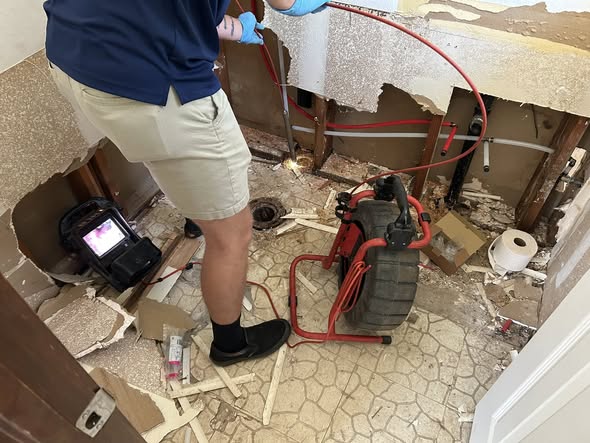
After we perform a full-diameter clearing or hydro-jetting service, we immediately send a high-resolution sewer camera down the line. We do this for two reasons:
First, it provides absolute proof that the root mass is entirely gone and the pipe is clear. You will see the empty pipe on the monitor yourself.
Second, it allows us to diagnose the structural integrity of the pipe. Roots enter through compromises in the line. The camera reveals whether you are dealing with a single separated clay joint, a localized offset, or a completely deteriorated and collapsed cast iron pipe.
We give you options, not ultimatums.
Some predatory operators will use the presence of roots to intentionally terrify a homeowner. They will run a camera, point to a root mass, falsely claim the entire line is "collapsed," and immediately pressure you into a $15,000 full-yard excavation.
Because we use a camera to reveal the mechanical truth, we can offer targeted, proportionate solutions based on the actual damage.
-
Chemical Root Maintenance (Copper Sulfate)
If the camera reveals that the pipe is structurally sound and merely suffering from minor joint separation, a full excavation is likely unnecessary. Instead, we can treat the line with professional-grade root inhibitors, such as Copper Sulfate. These foaming chemical treatments coat the walls of the pipe, killing the remaining microscopic root fibers on contact and preventing them from returning, without harming the tree itself.
-
Targeted Spot Repairs
If the roots have completely crushed a single section of pipe under your driveway, but the rest of the lateral is intact, we don't need to replace the entire line. We perform a sewer line repair by excavating only the damaged section, cutting out the shattered clay, and tying in a solid piece of modern PVC.
-
Schedule 40 PVC Replacement
If the camera shows that the legacy clay or cast iron pipe is shattered in multiple places, severely bellied, or entirely collapsed, a full replacement is the only mechanical fix. When we replace a main line, we use heavy-wall Schedule 40 PVC. Unlike clay, PVC joints are solvent-welded — chemically fused into one continuous run of pipe with no gaps for tree roots to breach. It is the permanent defense against root intrusion.
"They did not do work for us directly but we’re working on our neighbors sewer line. They had to dig in our yard to access the sewer. They were very communicative with us and respectful of our property and worked to leave our yard and fence in the same way they found it."
Straight Answers to Common Questions.
The only permanent solution to root intrusion is to eliminate the access point. This means excavating the affected section of the pipe and replacing the failing joints or cracked clay with solvent-welded, heavy-wall Schedule 40 PVC. Once the pipe is physically sealed, roots cannot re-enter.
Full breakdown → why sealing is the only permanent fix
A standard plumbing cable (snake) only pokes a small hole through the center of a root ball to let water pass. The remaining roots act like a net, catching toilet paper and debris until the line is completely blocked again within weeks. To actually remove the roots, the line must be scoured with a high-pressure hydro-jetter.
Full breakdown → why they grow right back
Chemical root killers can stunt future growth, but they will not remove an existing, physical root mass that is actively blocking your line. To clear an existing blockage, the roots must be physically cut or hydro-jetted out. Chemicals are only effective as a preventative measure after the line has been professionally cleared.
Full breakdown → what the store products really do
While copper sulfate is commonly used, we advise caution. Frequent use can be harsh on older cast iron pipes and may not be environmentally safe depending on your local municipal regulations. Professional mechanical removal followed by structural repair is the only guaranteed, long-term solution.
Full breakdown → the full safety ledger
From the Field Notes
Why Do Tree Roots Come Back So Fast After Snaking?
A cable pokes a hole through the root ball; it grows right back. The real fix.
Read itRoot killersDo Chemical Root Killers Actually Work?
What the store products do, what they don’t, and when they’re a waste of money.
Read it